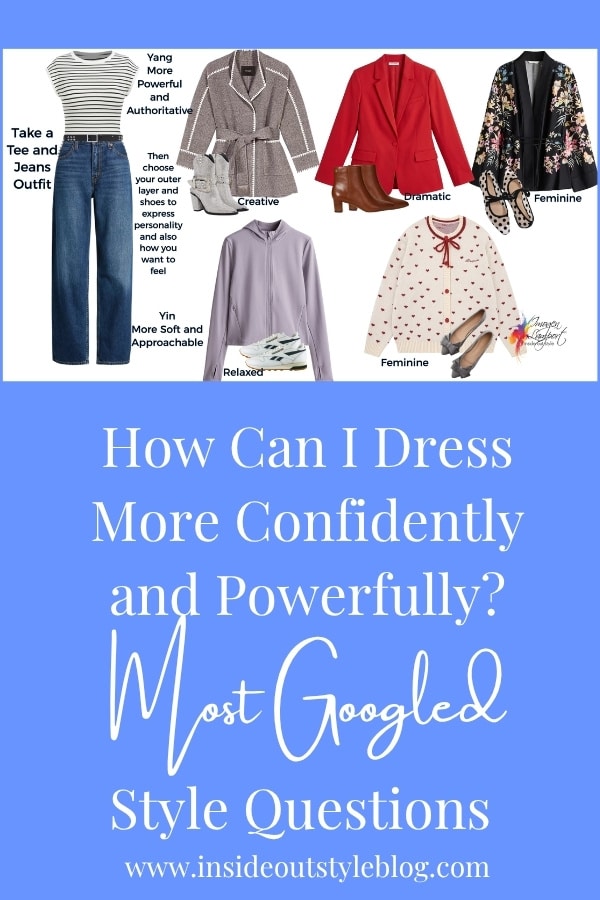


In our Prime 10 Most Googled Model Questions, the subsequent on our listing is “How Can I Gown Extra Confidently and Powerfully?”
It’s an attention-grabbing query, as analysis on confidence means that it comes from motion and constructing talent. Because of this simply following the model components of another person, who shouldn’t be you, received’t provide the confidence in your outfits that you simply need. As a substitute, it’s gaining the model schooling and information after which making the alternatives of clothes which might be an expression of one of the best model of you that gives you the boldness you need. Energy: effectively, having confidence could make you’re feeling extra highly effective, however there may be additionally a language of clothes that may enable you create a extra highly effective picture, which you can read about here.
The Confidence Fable That Retains You Caught
There’s a specific piece of recommendation that well-meaning individuals have been providing girls for many years, throughout self-help books, motivational content material, and elegance guides. It goes one thing like this: confidence comes from inside. True confidence is inner. What you put on doesn’t matter should you be ok with your self on the within.
It sounds clever. It sounds empowering. And it’s, in a selected and vital manner, utterly mistaken.

Not as a result of confidence is unimportant. Not as a result of interior work doesn’t matter. Nevertheless it presents confidence as a prerequisite for motion quite than a product of it. It means that you’ll want to really feel assured earlier than you possibly can gown confidently, which creates a round drawback for each girl who’s standing in entrance of her wardrobe at seven within the morning feeling something however.
The analysis tells a extra attention-grabbing and significantly extra helpful story. Confidence shouldn’t be a sense you’ve earlier than you interact with the world. It’s a state you construct via engagement with the world, and your clothes is without doubt one of the most fast and accessible instruments you’ve for constructing it.
What Enclothed Cognition Truly Means for Confidence
We explored the idea of enclothed cognition in What do your clothes say about you, within the context of how clothes impacts how others understand us. However the extra personally vital dimension of Adam and Galinsky’s analysis is what it reveals about how clothes impacts how we understand ourselves.
Their discovering, replicated and prolonged by subsequent analysis, is that clothes systematically influences the psychological processes of the individual sporting it. Not simply temper, although it impacts temper. Not simply confidence, although it impacts confidence. Precise cognitive efficiency. Precise behaviour. Precise outcomes.
Whenever you put on a garment that you simply affiliate with competence, authority, or functionality, you don’t simply really feel extra competent. You carry out extra competently. You assume extra abstractly, make higher choices beneath strain, and interact with challenges with higher persistence and creativity than you do in clothes you affiliate with passivity or informality.
This isn’t a placebo impact within the dismissive sense of that time period. The placebo impact is, itself, an actual psychological mechanism with measurable bodily outcomes. What enclothed cognition analysis demonstrates is that the symbolic which means we connect to clothes prompts corresponding psychological and physiological states. The garment is a set off. The boldness is actual.
Which implies that the recommendation “really feel assured earlier than you gown” has the sequence exactly backwards. Gown in a manner that prompts the psychological state of confidence, and the sensation follows.
Confidence Is a Bodily State, Not a Psychological One
This reframing turns into much more compelling after we think about the analysis on embodied cognition, the rising physique of proof that psychological states aren’t purely psychological phenomena however are constituted, at the least partly, by bodily expertise.
Amy Cuddy’s work on energy posing, whereas topic to ongoing scientific debate concerning the particular hormonal claims, contributed to a broader and extra robustly supported physique of analysis on the connection between bodily posture, bodily expertise, and psychological state. The core perception, supported by a number of strains of proof, is that the thoughts and physique aren’t separate techniques during which the thoughts points directions and the physique follows. They’re a single built-in system during which bodily states and psychological states repeatedly affect one another.
Clothes is a part of that bodily system. The bodily sensation of sporting a well-fitted, well-chosen garment, the best way it sits in your physique, the best way it strikes with you, the best way it feels towards your pores and skin, shouldn’t be separate out of your psychological expertise of sporting it. It’s a part of it.
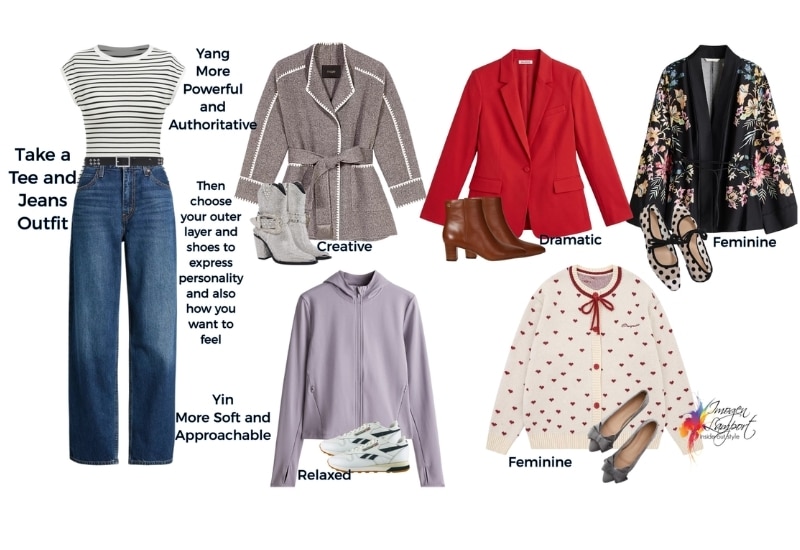
A garment that constrains you bodily creates psychological constraint. A garment that permits you to transfer freely and comfortably creates psychological freedom. A garment that matches your physique in a manner that feels safe and proper creates a bodily sense of being held collectively that interprets into psychological groundedness. An outfit that has extra Yang elements of design, gives you a extra highly effective look which might help construct your confidence. These aren’t metaphors. They’re the predictable outcomes of a mind-body system that doesn’t draw the boundary between bodily and psychological expertise, the place we habitually assume it falls.
 The Invisibility Phenomenon in Midlife Girls
There’s a particular confidence problem that I encounter with nice regularity in my work, and that deserves direct consideration: the expertise of feeling more and more invisible that many ladies describe as they transfer via their forties, fifties, and past.
This isn’t imagined. Analysis on age-related adjustments in social visibility, together with work by Hurd Clarke and Griffin on the cultural politics of ageing and appearance, has documented constant patterns of social invisibility skilled by older girls, patterns rooted in cultural narratives that affiliate femininity, attractiveness, and social relevance with youth.
The expertise of invisibility is, for a lot of girls, internalised as a private failing quite than recognised as a cultural phenomenon. The response, continuously, is to make oneself even much less seen, to decorate extra quietly, extra rigorously, extra safely, as if the answer to not being seen is to take up even much less area.
That is the other of what the analysis suggests really works and what my 7 Steps to Style members have skilled for themselves and reported again to me.
Research on the connection between look funding and social engagement in midlife and older girls persistently discover that girls who keep an lively, intentional relationship with their look, who proceed to decorate with care and self-expression quite than retreating into secure invisibility, report greater shallowness, stronger social connections, higher life satisfaction, and a extra sturdy sense of id continuity via the transitions of midlife and past.
This isn’t about chasing youth or conforming to standard magnificence requirements. It’s concerning the psychological perform of self-expression. After we cease expressing ourselves via our look, we lose one of many channels via which we talk our id to ourselves and to the world. And that loss has penalties that go effectively past how we glance within the mirror.
From Dressing To not Be Invisible to Dressing to Be Seen
The shift I’m describing, from dressing to keep away from discover to dressing to be seen, shouldn’t be primarily a shift in what you put on. It’s a shift in psychological orientation. And it’s, I wish to be clear, not essentially about turning into louder or extra conspicuous or extra demanding of consideration.
It’s about intention. About deciding, consciously and intentionally, that you’re price seeing and that your persona needs to be on the core of what you select to put on, quite than bowing to trend developments or what everybody else round chances are you’ll deem the precise factor to put on, which in actual fact is making you invisible. That your presence in a room is one thing to acknowledge quite than minimise, and that you’ve got knowledge and affect. That the lady you might be proper now, at no matter age and in no matter life circumstance you end up, deserves to be dressed with the identical care and a spotlight you may need given a youthful or extra conventionally seen model of your self.
That is, for a lot of girls, a genuinely radical act. We’re so effectively skilled within the artwork of self-minimisation, so practised at taking over much less area, asking for much less consideration, and making ourselves simpler to miss, that the easy choice to decorate as if we matter can really feel nearly transgressive.
Caring about what you put on is an act of self-respect. And like all acts of self-respect, it adjustments not simply how others see you however the way you see your self.
Taking your look severely shouldn’t be self-importance. It’s a type of self-knowledge and self-care with measurable psychological advantages. Tiggemann and Lacey’s research on clothes and physique picture discovered that girls who dressed with lively intention, making deliberate selections about self-presentation quite than retreating from it, reported considerably greater physique satisfaction and shallowness than those that dressed primarily to hide or minimise. Taking your look severely shouldn’t be self-importance. It’s, the analysis suggests, a type of self-respect with measurable and sturdy psychological penalties.
 How Color, Match, and Model Identification Construct Confidence Collectively
Carrying your finest colors removes one of the crucial fast sources of self-consciousness within the getting-dressed course of. When you recognize that the colors you might be sporting are working together with your colouring quite than towards it, you cease second-guessing the face trying again at you from the mirror. You arrive at appointments and conferences and social events with out the low-level nervousness of questioning whether or not you look one way or the other diminished or unwell. That could be a small and particular liberation, however it’s a each day one, and each day liberations compound.
Carrying garments that suit your precise physique, quite than approximating a match that’s shut sufficient and hoping nobody notices, creates the bodily groundedness described earlier. When a garment sits in your physique the best way it was meant to sit down, it doesn’t demand your consideration. It recedes into the background and permits you to inhabit it quite than handle it.
Dressing from a transparent model id, from a real understanding of who you might be and what you need your look to speak, removes the each day negotiation between competing aesthetics, competing variations of your self, and competing concepts of what try to be sporting. When you recognize your individual visible language, getting dressed turns into a affirmation of id quite than a seek for it.
These three issues collectively, proper color, proper match, proper id, are the inspiration of a wardrobe that builds confidence quite than depleting it.
The Compound Impact of Intentional Dressing
One of many issues I observe most persistently in purchasers who’ve performed this work is a compound impact that goes effectively past what they anticipated once they started.
They arrive to me believing that a greater wardrobe will make them really feel higher about their garments. And it does. However what additionally occurs, persistently and infrequently unexpectedly, is that the shift in how they gown creates a shift in how they inhabit their lives extra broadly.
Girls who’ve discovered their visible language report partaking extra readily in skilled alternatives they’d beforehand have declined. They provoke conversations they’d beforehand have prevented. They take up area, bodily and figuratively, in methods they’d stopped considering had been obtainable to them. They describe feeling, in numerous methods, extra like themselves, which is probably essentially the most vital end result of all.
That is solely in keeping with what the analysis predicts. If clothes systematically impacts psychological state, and psychological state impacts behaviour, and behavior impacts outcomes, then a sustained shift in the way you gown will, over time, produce a sustained shift in the way you interact together with your life.
Getting dressed effectively shouldn’t be a trivial exercise. It’s a each day apply of self-definition. And like all practices, its results accumulate.
Confidence Isn’t One thing You Really feel Earlier than You Get Dressed. It’s One thing You Construct Whereas Getting Dressed
You do not want to really feel assured earlier than you dress. You by no means did.
It’s essential to dress in a manner that builds confidence as you do it, that places you in bodily contact with clothes that activate a way of functionality and self-possession, that confirms your id quite than questioning it, and that communicates to the world, and to your self, that you’re somebody price taking severely.
The boldness comes from the apply. The apply is the dressing. Begin there, and the sensation follows.
Each single morning, you’ve a possibility to construct your self up quite than diminish your self, to affirm who you might be quite than disguise from it, to step into the day from a place of intention quite than apology.
That chance is hanging in your wardrobe proper now. It’s ready so that you can take it severely.
For those who’d love to essentially outline and refine your model, my 7 Steps to Style program is right here to provide the schooling in color and elegance you want.