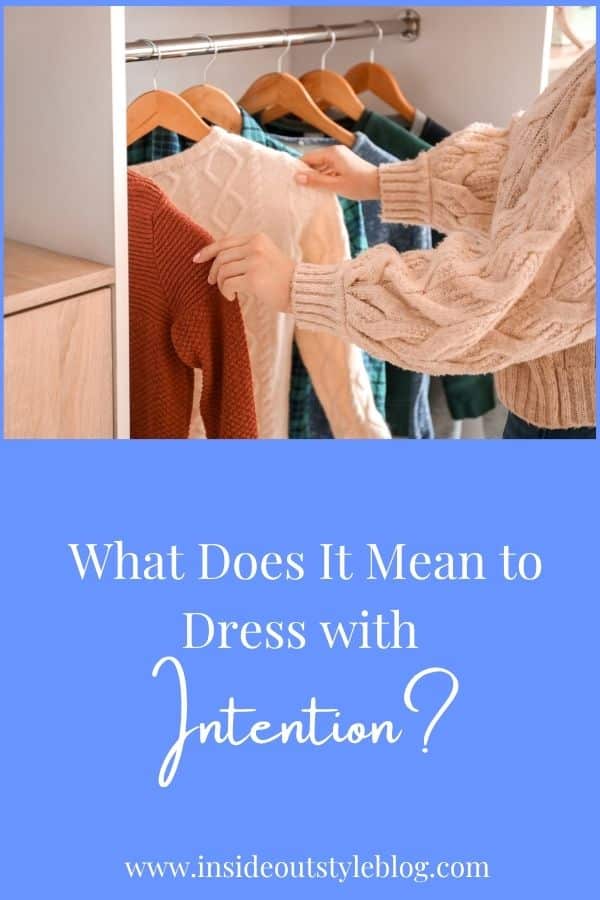



I do know the sensation of standing in entrance of a full wardrobe with nothing to put on. It’s probably the most frequent issues the ladies I work with inform me too. It’s straightforward to suppose that your wardrobe is missing; it wants a brand new garment or two, extra choices, extra selection. That doesn’t work except you actually have only a few garments. Your wardrobe grows, however the dissatisfaction stays the identical.
The issue is never amount. It’s purchasing and dressing on autopilot. Shopping for the identical type of gadgets again and again (what I now name the assault of the clone wardrobe), so even in the event you do have it in 3 colors, all of them really feel the identical, and that’s simply boring and a recipe for fashion dissatisfaction.
Purchasing with intention modified that. Not in a dramatic, in a single day approach, as I didn’t change my entire wardrobe without delay, however slowly, as my wardrobe turned extra me, my out there decisions improved. Right here’s what it really means, and why it’s finished extra for my confidence than any single merchandise I’ve ever purchased.
It’s Not About Attempting Tougher, It’s About Selecting on Goal
It begins within the shops. Earlier than you convey any garment residence, you need to make sure it’s going to earn its place in your wardrobe and develop into an integral piece of your fashion. If it doesn’t fill an precise wardrobe hole. If it’s just like what you personal and love however not an improve, a greater model. If it’s not an ingredient in your fashion recipe. Then don’t purchase it. Once you buy on autopilot, you find yourself with a boring wardrobe. Once you purchase “totally different” since you’re bored, however you don’t perceive what your form of totally different is, you find yourself with a wardrobe of things you don’t put on as a result of they’re not you (and that’s simply wasteful muddle). Should you purchase it since you noticed another person sporting it, whether or not in actual life or on social media, however you haven’t really thought of if it’s since you prefer it on them and in case you have the same physique, way of life, colouring and persona, then it’s most probably not going to be just right for you.

As an alternative, you need to put money into the items you’ll put on many instances, in numerous outfits and mixtures. Clothes you may costume up or down, like the clothes I’m sharing on this put up, that are frequent staples, however I’m not sporting them in a “uniform fashion” approach.

Perceive that it’s a lot more durable to let go of one thing when you personal it, so making the most effective choices attainable within the retailer is crucial, and it’s why having a color palette that works (and all the colors work collectively), understanding your finest silhouette, and having a superb grip of how your persona influences each fashion selection. These are all of the issues you might want to study earlier than you buy groceries. It’s onerous to decorate with intention when what you could have isn’t the appropriate issues for you.
Dressing with intention doesn’t imply spending extra time, more cash, or extra psychological power on what you put on. Some mornings my “intentional” selection takes ten seconds, as a result of I already know what helps me.
It means making the selection on objective, moderately than letting it occur to you. Image reaching for a prime as a result of it was on prime of the pile. Now image reaching for it as a result of you understand it makes you’re feeling calm and succesful on a giant day. Identical prime. Fully totally different relationship to it.
I consider it because the distinction between a wardrobe that’s simply full, and one which’s full of choices you’d make once more.

There’s additionally some genuinely fascinating analysis behind this, not proof precisely, however a helpful trace that it isn’t only a good concept. Psychologists finding out what’s known as enclothed cognition have discovered that sure clothes, worn with a specific that means connected, can measurably shift how the wearer thinks in that second. Individually, extra formal clothes has been related to extra summary, big-picture pondering, although later research have produced combined outcomes, so it’s a discovering value holding flippantly moderately than treating as a rule.
None of which means the appropriate jacket will repair your life. It’s nearer to this: garments aren’t at all times psychologically impartial. Generally they’re doing one thing to you, whether or not you’ve chosen them on objective or not, which is actually the center of what I imply after I discuss confidence as a physical state rather than a mental one: the blazer modifications the way you sit earlier than it modifications what anybody thinks of you. Intentional dressing simply means you get extra say in what that one thing is. (If you wish to learn the unique examine, Adam and Galinsky’s 2012 paper on enclothed cognition is the supply most of this analysis traces again to.)
 What Intentional Dressing Really Appears to be like Like
It’s not a uniform, and it’s not essentially minimalism, though it could appear like both if that genuinely fits you. For me, it seems to be like a number of small habits:
- Asking how I need to really feel that day, earlier than I ask what I really feel like sporting. A peaceful blue shirt does a distinct job to a daring print one, and each have their place relying on my temper.
- Figuring out my colors and shapes effectively sufficient that almost all of what’s in my wardrobe already works, so I’m selecting between nice choices moderately than playing.
- Not getting dressed straight out of the clear washing basket, since these are your fallback uniform moderately than what you need to appear and feel like at present.
- Avoiding sporting issues out of guilt (“I paid good cash for this”) moderately than real liking. That’s often an indication it wants to depart.
- Getting dressed as a small ritual moderately than a rushed job squeezed in between the bathe and the door. Even somewhat further area modifications the tone of the entire selection.
None of this requires an even bigger wardrobe, or a smaller one for that matter. It simply will get simpler if you’re not sorting by means of a pile of belongings you don’t actually need to put on. I explored this correctly in The Thoughtful Wardrobe: What You Gain When You Buy Less, which is the pure subsequent learn after this one.
Why This Isn’t the Identical as Dressing for Different Folks
Some folks deal with “intentional dressing” as efficiency for an viewers. Dressing for the job you need, the room you’re about to stroll into, the model of your self different folks count on. That’s not what I imply, and it’s value naming the distinction as a result of it’s a simple entice.
Dressing with intention begins from the within. It then consciously takes the context into consideration, moderately than letting the context determine for you. Generally these two issues overlap utterly: a tailor-made jacket can genuinely make you’re feeling extra succesful and learn as extra succesful in a gathering.
The event nonetheless issues. The distinction is that you simply’re the one weighing it up, not silently absorbing regardless of the room appears to count on, which is strictly the stress I saved circling again to after I wrote about building a work wardrobe that reads as professional without feeling like a costume, if work dressing is the place this feels hardest for you.
The Half No one Warns You About
Right here’s the trustworthy bit. Dressing with intention will sometimes imply disappointing folks, together with past-you. You would possibly cease sporting belongings you spent good cash on, as a result of they have been purchased for a model of you that’s moved on. You would possibly cease dressing to mix in, and see folks touch upon it.
I don’t suppose that’s an issue to repair. It’s extra {that a} wardrobe constructed on autopilot tends to replicate whoever was influencing you on the time- a sale, a development, {a magazine}, an algorithm- and a wardrobe constructed with intention displays you as an alternative, which is a a lot smaller and extra fascinating group of influences to reply to. If that is the half that resonates, Why Your Wardrobe Doesn’t Feel Like You, and What to Do About It goes deeper into precisely this hole between who you have been and who you are actually.
 The place to Begin This Week
You don’t must overhaul something to start. Choose one morning this week and, earlier than you open the wardrobe, ask your self the way you really need to really feel that day. Then select with that reply in thoughts moderately than behavior. Discover what’s totally different, not simply within the outfit, however in how the day goes.
Should you’d like a correct framework for making these decisions effectively, moderately than working it out piece by piece the best way I did, that’s precisely what 7 Steps to Style walks you thru.
What does dressing with intention appear like for you? I’d love to listen to within the feedback.
Extra Ideas
Wearing Clothes You Hate? It’s Time for a Wardrobe Revolution!