

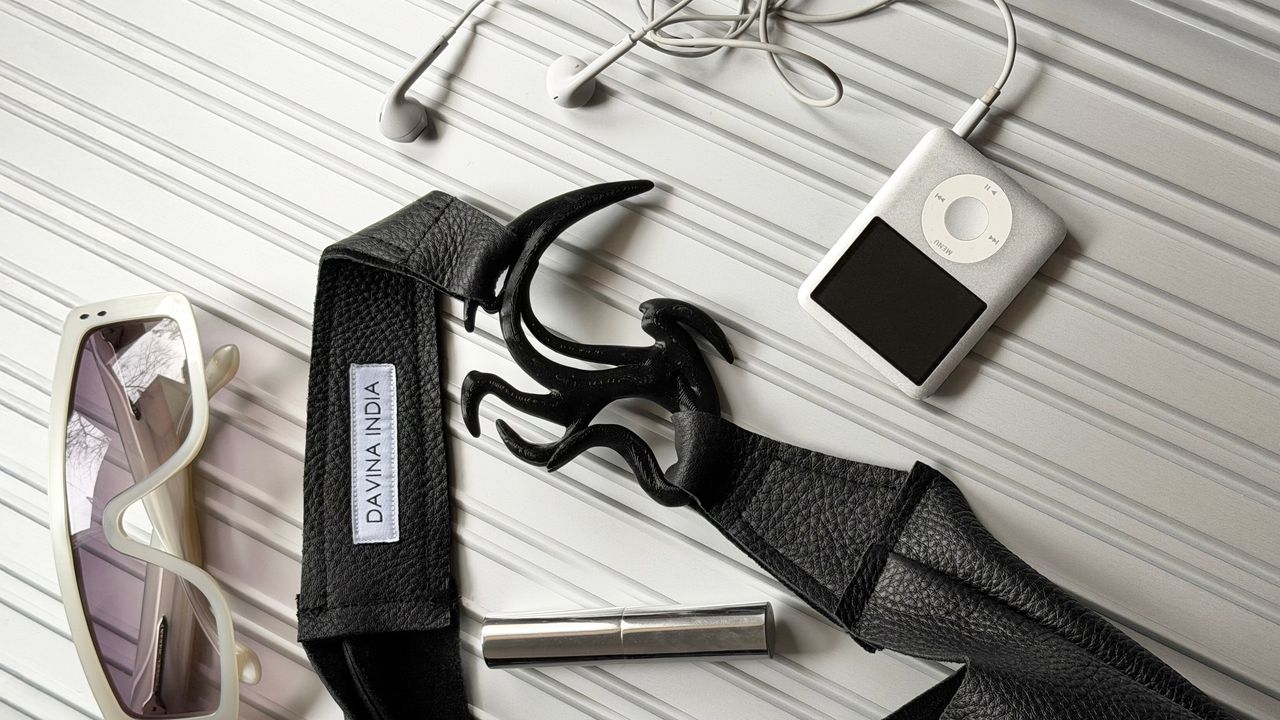
It’d be straightforward to dismiss it as simply one other pattern, yet one more “-core” that’ll really feel drained in a matter of weeks. However in contrast to so many so-called aesthetics, this one displays one thing bigger.
“Within the early 2000s, there was a really clear and optimistic imaginative and prescient of the long run,” says Davina India, an indie designer whose work melds conventional textiles with molten, 3D-printed types. “Brilliant, shiny, virtually clear, with a powerful sense of concord between nature and expertise. That sort of aesthetic imaginative and prescient feels largely absent immediately, and I feel it’s essential to reconnect with it and begin translating these optimistic concepts into actuality.”
With AI information facilities worsening our power disaster and Silicon Valley champing on the bit to safe contracts with the Division of Protection, and algorithmic feeds and AI slop have sapped the enjoyable from the web, and each laptop computer and smartphone seems to be as smooth and boring and boring as the subsequent, that expertise isn’t inherently so dystopian, so regimented — sapped of the that means and mythos that people crave. In Glitch Gothic, a portal to a different, extra imaginative world reopens, the place the twain would possibly meet. “Each the magical and the futuristic describe one thing past our present actuality, one thing we will’t absolutely outline but, however can envision,” India provides.
Fact is, we’ve been quietly trending towards techno-mysticism for a while. Artists have been exploring the overlap between the spiritual and the technological for years. Standard apps hyperlink the religious and the technological: Co-Star claims to parlay AI into astrological insights; Stardust purports to weave machine-learning algorithms with “historic knowledge” to assist customers perceive their menstrual cycles. LLM chatbots have the paper of record brazenly musing in regards to the relationship between expertise and faith. (The massive secret? This isn’t a radical departure; it’s a return to the norm. In historic occasions, it was astrologers who mapped the skies, innovated complicated algorithms, and invented the astrolabe; trendy computing descended from the punched-card loom, an innovation in textile manufacturing; Nikola Tesla considered literature and artwork whereas he tinkered with electrical energy, and likewise sought to commune with aliens. Pay attention, it was price a shot.)
One other key component of Glitch Gothic is that it reminds us that craft nonetheless has a spot in our tech-mediated world. It’s straightforward, within the age of “the cloud,” to neglect that even our most superior applied sciences depend on materials, tactile methods — and that these identical machines may be harnessed by artisans. “I take advantage of laser slicing in my work as a result of it permits for precision and adaptability, however I all the time end items by hand,” says Eleni Ioannidou, the designer behind furnishings and equipment label 100100. “I like maintaining small imperfections as a result of they remind you that an individual was concerned within the course of.”
Imperfections — glitches, in different phrases. Their presence a function, not a bug.
