

You want to know where men’s fashion is heading? Follow the geeks.
These are the obsessives, fixated, with a NASA technician’s precision, on how their pants fit or on which pair of Paraboot shoes is the correct pair. These are the obsessives who in the aughts were early to selvage denim (now available at a Uniqlo near you!) and soft-shouldered Italian tailoring in the mode that, eventually, trickled down to your local J. Crew.
And where has the attention of this cohort landed now? On a vanguard of newish-to-the-West labels from Japan, like A.Presse, Comoli, Auralee and T.T.
1
A.Presse is probably the most hyped of this cohort. What other label is worn by the French soccer player Pierre Kalulu and the actor Cooper Hoffman and has men paying a premium for a hoodie on the resale market? Kazuma Shigematsu, the founder, is not into attention. When we spoke, he wouldn’t allow me to record the conversation. Notes only.
“You imply a better-fitting denim jacket that’s based mostly on an outdated Levi’s factor? Yeah, OK, offered,” mentioned Jeremy Kirkland, host of the “Blamo!” podcast and the textbook definition of a latter-day Japanese males’s put on man. Mr. Kirkland, as soon as somebody who would allocate his funds to Italian fits, admitted that, just lately, over the course of two weeks, he purchased 4 (sure, 4) jackets from A.Presse1.
“I’m not really experimenting with my style anymore,” Mr. Kirkland said. “I’m just wanting really good, basic stuff.”
Basic though these clothes appear, their hook is that they’re opulent to the touch, elevated in their fabrication.
2
Over the years, the designer Ryota Iwai has told me repeatedly that he is inspired by nothing more than the people he sees on his commute to the Auralee offices in Tokyo. When asked recently if he collected anything, he said nothing — just his bicycle.
3
The true somber tale of this wave. The brand’s founder, Taiga Takahashi, died of an arrhythmia in 2022 at 27. The label has continued to plumb history for inspiration. The latest collection had pieces that drew on bygone American postal-worker uniforms.
An Auralee2 bomber seems pedestrian till you contact it and notice it’s silk. Labels like T.T3 make garments that echo the specs of a classic relic but come manufacturing facility contemporary, notched up, made … nicely, higher. They bestow upon the wearer a sure in-the-know authority.
And so there is a hobbyist giddiness present on Discord channels where 30- and 40-something men trade tips on how to size moleskin trousers by the Japanese label Comoli; at boutiques like Neighbour in Vancouver, British Columbia, where items like a $628 dusty pink trucker jacket from Yoko Sakamoto and an $820 T.T sweater sell out soon after hitting the sales floor.
What’s notable is how swiftly these geeky preferences have wiggled into the broader fashion community. While I was in Paris for the men’s fashion shows a year ago January, all anyone wanted to talk about were things with a “Made in Japan” tag. I would speak with editors who were carving out room in their suitcases for Auralee’s $3,000 leather jackets.
But these were clothes being shown away from the fashion week hordes. The A.Presse showroom was on a Marais side street in a space about as long as a bowling lane and scarcely wider that was crammed with racks of canvas, silk and denim jackets with Pollock-like paint splatters. There were leather jackets as plush as Roche Bobois sofas and hoodies based on sweatshirts made in America a half-century ago.
I got the hype. After 10 days of puzzling over newfangled stuff on the runways, the display of simple, understandable shapes we’ve known our whole lives, but redone with extra care, couldn’t have felt more welcome.
Kazuma Shigematsu, the A.Presse designer, said he had collected a trove of vintage pieces that he housed in a separate space to plumb for inspiration. He made new clothes based on old clothes that benefited from a century of small design tweaks.
By this January, A.Presse had upgraded to a regal maison facing the Place des Vosges, with giant windows and even more reverent hoodies, even more tender leathers. Back in America, I asked an online department store executive what his favorite thing from Paris was. He took out his phone to show me photos of himself trying on a zip-up leather jacket in A.Presse’s high-ceilinged showroom.
On Their Own Terms
4
“We never think about trendiness or popular design details,” Ms. Sakamoto said through a translator. “It’s more like functionality, everyday use.” The label has a thing for natural dyes: pants stained with persimmon tannin, yellow ochre and sumi ink, shirts colored with mugwort and adzuki beans.
The sudden reputation of those labels outdoors Japan could make it really feel as if they’re new. But every label has constructed a decent enterprise inside Japan, some for greater than a decade. Auralee was based in 2015. A 12 months later, Yoko Sakamoto4 began its line. A.Presse is the relative child of this cohort at 5 years outdated.
“A couple years ago, we would have to buy off the line sheet or go to Japan and see everything,” said Saager Dilawri, the owner of Neighbour, who has an instinct for what spendy, creative types lust after. “Now I think everyone from Japan is trying to go to Paris to get into the international market.”
This movement’s “Beatles on Ed Sullivan” moment occurred in 2018, when Auralee won the Fashion Prize of Tokyo, granting the designer, Ryota Iwai, financial support. Soon after, Auralee was given a slot on the Paris Fashion Week calendar.
“I had never seen a show before, never thought to do it,” Mr. Iwai said through a translator in February, days after his latest runway show. He has now done five.
As we talked, buyers speaking different languages entered his storefront showroom and ventured upstairs to scrutinize items like a trench coat that looked as if it was made of corduroy but was actually made from cashmere and wool and an MA-1 bomber jacket with a feathery merino wool lining peeking out along the placket.
5
The Cale designer Yuki Sato travels throughout Japan to find textiles. Unusually, the company manufactures everything, including leather and denim, in one factory.
At Cale’s5 show off Place Vendôme, the designer Yuki Sato described denim trousers and pocketed work jackets as “modest, however perfectionist.” On the opposite aspect of town, at Soshi Otsuki, whose 11-year-old label Soshiotsuki has gained consideration for its warped imaginative and prescient of salary-man fits, I encountered patrons from Kith, a New York streetwear emporium higher identified for promoting logoed hoodies and sell-out sneakers than for tailoring.
6
Nearly a decade into its existence, Soshiotsuki has hit a hot streak. Soshi Otsuki won the LVMH Prize in 2025, and he already has a Zara collaboration under his belt. An Asics collaboration is set to arrive in stores soon.
Speaking via translators with these designers, I started to fret that it may be unfair to group them collectively just because they have been all from Japan. Auralee simmers with colours as lush as a Matisse canvas, whereas Comoli’s brightest shade is brown. Soshiotsuki6 has mastered tailoring, whereas Orslow is thought for its faded-at-the-knee denims channeling decades-old Levi’s.
Rather, as with the Antwerp Six design clique that sprung out of Belgium in the early 1980s, it is these labels’ origin stories that thread them together.
“They’re being encountered on their own terms and respected on their own account, and they happen to be Japanese,” said W. David Marx, the author of “Ametora: How Japan Saved American Style” and a cultural critic who has lived in Tokyo for more than two decades.
“It is a new era of Japanese fashion on the global stage,” Mr. Marx said.
A Love Affair With Japan
Western shoppers have a history of falling hard for clothes from Japan. In 1981, when Rei Kawakubo of Comme des Garçons and Yohji Yamamoto crashed onto the Paris fashion scene, buyers swooned for their brainy, body-shrouding creations.
7
Recently reintroduced as Number(N)ine by Takahiro Miyashita.
Years later, Quantity(N)ine7 and A Bathing Ape synthesized traits we might name American — grunge, streetwear and hip-hop — polished them up and offered them again to the West.
8
Years before American men were trawling the internet for A.Presse, they would scour forums for deals on Visvim’s jeans and sneakers. Today, Visvim has stores in Santa Fe, N.M.; Carmel, Calif.; and Los Angeles.
Into the 2000s, clothes geeks have been swapping tips about boards like Superfuture and Hypebeast about methods to use a Japanese proxy service to purchase Visvim’s8 seven-eyelet leather-based work boots or SugarCane’s brick-thick denims.
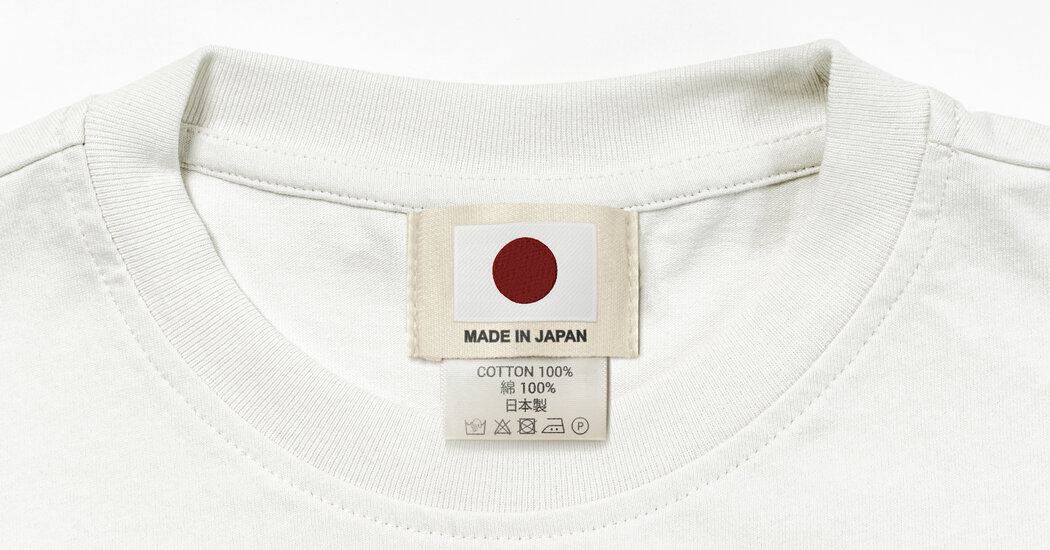
Along the way, “Made in Japan” became a shorthand for “made well.” This was more than fetishization. As America’s clothing factories became empty carcasses pockmarking the heartland, Japan’s apparel industry grew steroidal.
“Japan still has an incredible manufacturing base for apparel that goes all the way from the textiles to the sewing to the postproduction,” Mr. Marx said.
Today, many Japanese labels produce most of their garments and, crucially, their textiles in Japan. When I first met Mr. Iwai years ago, I asked how he managed to create such lush colors. He answered, as if noting that the sky was blue, that he worked with the factories that developed his fabrics. As I spoke with Mr. Sato in January, he shared that Cale’s factory had been in his family for generations and also produced for other Japanese brands that I would know.
Chris Green, the owner of Ven. Space, a boutique in the Carroll Gardens neighborhood of Brooklyn that has helped to introduce a number of these labels to an American market, suggested that because Japan is a small country with a fervent fashion culture, a competitive spirit has been stoked.
“They have to be able to cut through the noise,” Mr. Green said, with brands trying to prove that their cashmere sweater can outclass their peers’, that their silks are sourced from finer factories. What’s more, he said, once these brands have nailed a design, they stick with it. That is something that is important to men, in particular, who hate when a brand abandons its favored pants after a season.
Before he opened Ven. Space in 2024, Mr. Green was an admirer of many of these labels, purchasing them during trips to Japan. As we spoke, he was wearing a pair of Comoli belted jeans that he bought five or so years ago. A similar style is still available.
Primed for What They Were Pitching
At the close of the 2010s, streetwear was running on fumes. Quiet luxury was entering at stage left. If the Row and Loro Piana were expert at subtle, fine-to-the-touch clothes, so, too, were the likes of T.T, Graphpaper and Yoko Sakamoto.
“I went from this guy that wears pear-shaped pants to just wearing, like, a denim jacket,” said Chris Maradiaga, a tech worker and freelance writer in Vancouver. His wardrobe today consists of Comoli’s black-as-night trousers and a purple-tinged coat by Ssstein. His kaleidoscopic Bode jackets gather dust.
That Ssstein clothes have landed in the closets of men on the other side of the world defies the early guidance relayed to Kiichiro Asakawa, the label’s bushy-haired designer. His “senpais,” or mentors, warned him that his reduced designs might leave Western audiences cold. “You need something powerful,” they told him.
He tried, but it wasn’t necessary. It’s the most minimal designs — his cotton gabardine zip-ups, his “easy” pleated trousers — that people are most interested in now. “It actually makes me very happy,” he said through a translator. “My instincts were right.” Mr. Asakawa won the Fashion Prize of Tokyo in 2024.
Adapting to North American Markets (and Men)
Several Japanese designers noted that they had modified their sizing to accommodate larger, American bodies.
“I’ll ask them, Can you lengthen the pants by three centimeters? Because you need that for the Western market,” Mr. Dilawri of Neighbour said, noting that the designers were receptive to those requests.
A number of labels, like Comoli and Soshiotsuki, are already oversize. That’s the look.
9
Kiichiro Asakawa ran a Tokyo boutique, Carol, before starting Ssstein in 2016. It’s still there. He, too, said he found inspiration in the everyday, for example when watching an elderly couple have dinner across a restaurant.
There may be additionally the matter of value. On the entire, these garments aren’t low-cost. See Auralee’s silk bomber jacket, which may very well be army surplus however feels stolen from a sultan’s palace. It’s roughly $1,700. Ssstein’s9 Carhartt cousin chore jacket with a cowhide collar and a factory-massaged fade? About $1,000. Anybody who has traveled just lately in Japan, the place the yen is tantalizingly weak, will let you know that these Japanese-made garments, after being imported, are far pricier in North America.
Yet, as luxury fashion labels continue to price out the aspirational middle-class shopper, many of those same shoppers have convinced themselves that the Japanese labels are a better value. A cashmere coat at Prada is $10,000, and you’ll need $1,690 to own a cotton-blend cardigan from Margiela. Similar pieces from Japanese labels can be half that price, or less.
“Brands like Bottega, Balenciaga, the Row — all that stuff — are so unobtainable,” said Mr. Kirkland, whose clothing budget has shifted to A.Presse. “I will never be in that price bracket,” he added, “but I’m wealthy enough to buy a chore coat for $800.”
Of course, Mr. Kirkland and all of the fans of these labels could own a chore coat for far less — but then it wouldn’t be “Made in Japan.”
